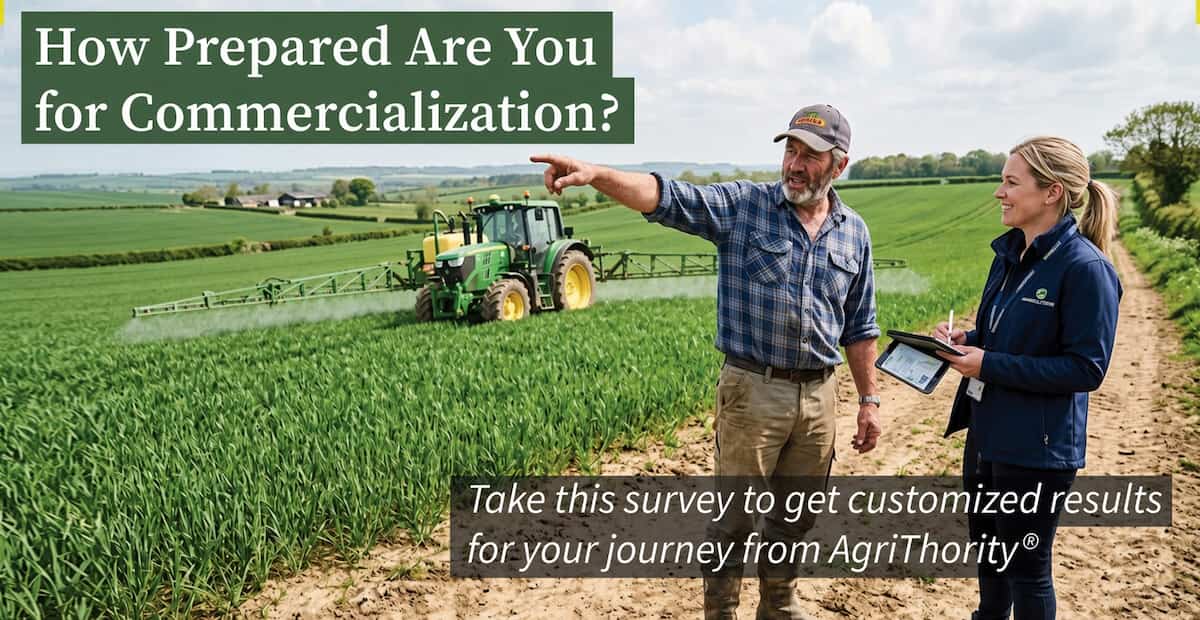
Despite significant headwinds in the agricultural market, development of new agricultural innovations continued to move forward. The AgriThority® team garnered insights across multiple regions during the past year, revealing critical patterns that will shape the year ahead. As an industry, the learnings help improve development moving forward.
Grower Realities Should Shape Development
Economic pressure fundamentally changes grower behavior toward more data-driven decisions with less risk, especially when adopting new technologies. This shift requires companies to strengthen their product validation, trial quality, and performance consistency.
“In 2025, client work clearly reflected the increasing pressure on margins across the ag industry,” said Fabrizio Giolo, Ph.D., Product Development Manager. “In a highly competitive environment, growers are prioritizing products that deliver proven performance and clear return on investment (ROI). Value propositions based solely on promises or positioning are no longer sufficient.”
Early Regulatory Planning and Execution Leads to Higher Chance of Success
The regulatory landscape for agricultural products continues to evolve globally, particularly for biologicals. George Fountas, Global Director, Regulatory Affairs said, “In 2025 our consulting work reinforced the idea that the earlier regulatory needs are considered, the higher probability of marketability. This allows development of claims architecture first and then supporting data generations rather than the other way around.”
The consequences of getting this wrong can be significant. When clients develop supporting data without understanding the regulatory implications, often the data is unusable, or it pushes the project into a regulatory category that doesn’t fit the business case.
“The biological products sector faces particular regulatory scrutiny,” Fountas notes. “As the biological industry grows, these products are no longer automatically considered low risk. Guidance documents have been and are continuing to be released that clarify, but also likely increase the data requirements on biological products.”
Argentina’s regulatory landscape remains in flux. Fountas notes, “Argentina’s regulatory system has gone through a lot of changes over the past three years. Having a local group, as AgriThority does, has proven to be vital to navigating this changing process.”
Meanwhile, opportunities are emerging in other regions. Many African, Middle Eastern, and Eastern European regions are rapidly reforming their regulatory frameworks to align with international standards. In the Middle East, there is a strong push to enhance food security through foreign investment and agri-food innovation, creating growing demand for technical due diligence services in the region.
This increasing complexity is affecting market strategies. At ABIM 2025, companies said they are now primarily seeking to acquire biological product portfolios that either already have regulatory approvals or are at an advanced stage of the registration process, with approvals imminent.
LATAM Growers are Becoming More Cautious
Different regions present distinct opportunities and challenges. In South America, Paraguay has become a highly strategic region for product development as part of access the Brazilian market. Its environmental similarity to key Brazilian regions, combined with simpler product importation, makes it an efficient platform for early-stage testing and evaluation. Brazil itself presents a mature but challenging market.
“While products are well established, the high number of companies and offerings has made growers more cautious,” Giolo explains. “There is growing skepticism toward performance claims that are not supported by robust, transparent data.”
Meanwhile, many companies have been accelerating development and launch timelines, which often creates gaps in product development processes, trial rigor and performance validation. Grower caution combined with accelerated timelines can create a perfect storm for companies launching new products. Establishing a standard, uniform development process that combines strategic with scientific direction and execution to meet industry expectations and farmers’ needs is essential. The stage-gate process can help avoid unnecessary risks and wasted resources.
Interest in Biorational Solutions Continues
Despite the challenges, opportunity persists in specific segments. Indications are still in favor of continuing interest in biorational solutions. However, success in this space requires navigating an increasing complex regulatory environment where the number of biological products are not only growing, but are also expanding into new territories. Peptides, RNAi (RNA interference), CRISPR, microbials and other developing technologies are pushing the boundaries of regulatory.
“AgriThority has witnessed clients historically underestimating the complexity of scaling biological innovations, often investing heavily in early-stage technologies,” says Oluwatobi (Tobi) Oni, Ph.D., MBA, Business Manager (Europe, Middle East & Africa). “However, tightening regulations across multiple jurisdictions, particularly in Europe, have delayed many of these innovations from reaching the market in a timely manner. While the appetite for technology investment remains, companies are approaching it with greater caution.”
Reach out to AgriThority® for your business, market and product development needs, as well as regulatory and sustainability counsel. Our international footprint, combined with our deep understanding of the market and producer dynamics, helps you to leap hurdles and overcome barriers to set up your products for success.