
Developing a commercially viable formulation is a critical step in the early-stage development of a pesticide, biostimulant, fertilizer, or any type of crop production input. Formulation development should begin as soon as the active ingredient (AI) is identified, screened or scoped for potential, and a decision is made to develop it into a commercial product.
Special Considerations for Microbial Pesticides and Biostimulants
Microbial pesticides and microbial biostimulants are often grouped with conventional agricultural inputs, but their formulation presents a fundamentally different challenge. In most of these products, the active ingredient is a living organism—or a biologically active structure such as a spore that must remain sufficiently viable, stable, safe, and functional from fermentation through storage, distribution, mixing, application, and establishment in the field.
A successful microbial formulation must therefore do more than disperse an active ingredient. It must preserve the biological identity and activity of a particular microbial strain, protect it from environmental stress, deliver an effective dose to the correct biological target, and meet manufacturing and regulatory specifications throughout its shelf life. These requirements make formulation development inseparable from strain selection, fermentation, quality control, packaging, application technology, and regulatory strategy.
For conventional chemical AIs, the solvent or carrier must be chemically and physically compatible with water and all other components in the formulation.
The carrier for a microbial AI must meet the following requirements:
- Be nontoxic to the microbial strain at the intended concentration.
- Maintain suitable moisture content and water activity.
- Provide acceptable pH, ionic strength, and osmotic conditions.
- Protect the organism during drying and storage.
- Disperse or suspend adequately in the application medium.
- Produce acceptable flowability and low dust.
- Pass through pumps, screens, and nozzles.
- Adhere to the seed, foliage, root, or soil target as required.
- Be commercially available with consistent composition and microbiological quality.
- Meet regulatory and residue requirements for the intended market.
Active Ingredients Are Just the Beginning
Non-active ingredients that may be necessary or beneficial in a formulation include a whole range of diluents, solvents, surfactants, penetrants, emulsifiers, suspending agents, sequestering agents, buffering agents, stabilizers, thickeners or agents for drift reduction, volatility reduction, dispersion, antifreeze and antifoam, or even antimicrobial preservatives. The critical product testing in the field, greenhouse or laboratory must be conducted using the formulation that will eventually be sold to the farmer. If a formulation is modified during the development process, the previous testing, other than initial screening, will be rendered invalid and must be repeated with the formulation to be commercialized.
Early identification of a viable formulation is also critical for regulatory efficiency. Required regulatory studies with the formulation may have to be redone if even a small change is made in formulation ingredients. Extensive delays in registration time and increased cost of registration can occur if all ingredients in the formulation are not approved by the appropriate regulatory agencies. These regulations vary from country to country and state to state, so even the early strategic plan should include the pathways forward for expansion once commercialized.
A commercially viable formulation is one that meets criteria that includes:
- convenient application and handling,
- maximum activity,
- relative safety for workers, users and crops,
- stable in storage as well as when mixed with water or other pesticides with which it may be applied
- only approved ingredients in addition to the AI, and
- compatible with other pesticides with which it is likely to be tankmixed.
The minimum assessment to confirm commercial acceptability of a formulation should include testing for stability while packaged, stored and when mixed for application. Evaluation of stability requires evaluation for physical and chemical stability and, for microbial pesticides, biological stability.
Some formulation testing may be required by regulatory agencies, but additional testing is advised for acceptance by distributors, dealers and farmers. Of most importance to dealers, distributors and farmers are tests to confirm compatibility and storage life of the formulation.
What’s Water Got To Do With It?
For most formulations, compatibility with water is necessary. Water quality varies greatly with geographical location. Water hardness or mineral content is a major challenge for many formulations. Extremely hard or soft water can cause problems with formulations that result in a mixture that cannot be sprayed or may be sprayable but is no longer active for the desired purpose. Water quality varies considerably across the U.S. Figure 1 presents data from a United States Geologic Survey (USGS) study across the U.S. Approximately 2,100 wells were sampled, and it is easy to see the challenge this presents to pesticide manufacturers and farmers. Formulation testing should include testing for physical, chemical and biological compatibility with a minimum of three hardness levels of water to confirm compatibility. In-field testing should always document the water characteristics to determine any impact from salinity, pH or thresholds of elements.
Table 1: Hardness of groundwater from domestic wells, a USGS study
A study from the National Water-Quality Assessment (NAWQA) Project assessed water-quality conditions for about 2,100 domestic wells across the United States. Water hardness was one water-quality parameter studied; results are shown in the map below.
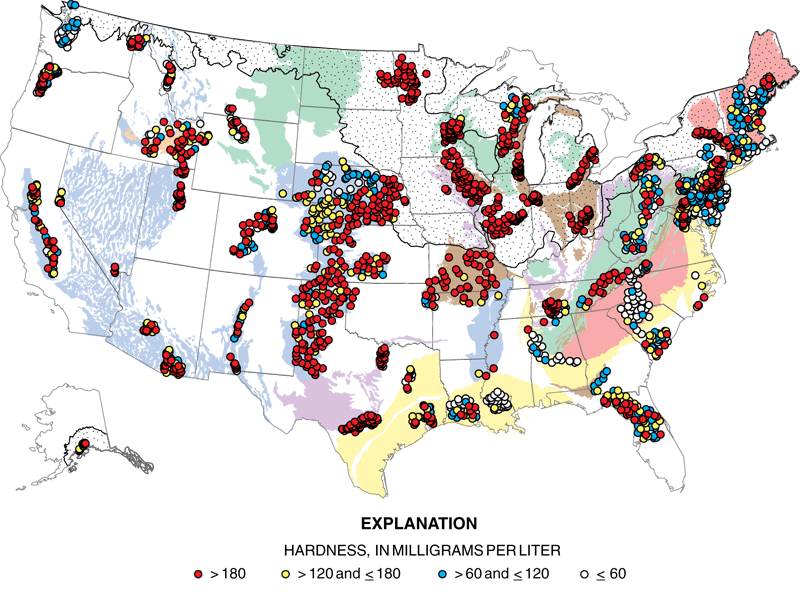
Water Hardness Scale
Water hardness is measured in milligrams per liter (mg/L), parts per million (ppm), or grains per gallon (gpg).
- Soft: < 60 mg/L (or < 3.5 gpg)
- Moderately Hard: 61 – 120 mg/L (or 3.5 – 7 gpg)
- Hard: 121 – 180 mg/L (or 7 – 10.5 gpg)
- Very Hard: > 180 mg/L (or > 10.5 gpg)
Compatibility of a formulation with other inputs that may be mixed with it is also important. Physical compatibility of a specific tank mix can be tested in the field, and many product labels include instructions for conducting this test called a “jar test.” A jar test, however, cannot determine chemical or biological compatibility. It is recommended that key tank mix partners should be identified and evaluated for compatibility prior to commercialization. Acceptable tank mixes can then be listed on the product labels along with any mixing instructions unique to the specific mixture.
Formulation development and the required testing to assure commercial viability of the formulation should be an integral part of the strategic business plan and begun early in the scoping stage of the development process. AgriThority® has the expertise and experience to advise formulation development needs and coordinate the required testing, including physical, chemical and biological compatibility testing as well as spray tank and storage stability. Application technology testing experience includes wind tunnel studies to determine drift potential and humidome studies to determine volatility risk of formulations and mixtures of formulations.
When your innovation is ready for development, turn to AgriThority for the strategic and scientific development expertise that can make the difference between a great idea and a breakthrough. Our global footprint, combined with deep understanding of market and producer dynamics, helps move your innovation from the laboratory to market.
Bibliography
Burges, H. D. (Ed.). (1998). Formulation of microbial biopesticides: Beneficial microorganisms, nematodes and seed treatments. Springer. https://doi.org/10.1007/978-94-011-4926-6
Calvert, David, Mike Sdoudi and Darryl Ramoutar (2026) Review of impacts on biological products of inerts used in formulations. Podcast sponsored by AgriBusiness Global and Gaylord Chemical (gChem). https://event.webcasts.com/starthere.jsp?ei=1762769&tp_key=6c86d8c48f
Daniels, John, (2020) Water Quality and Pesticide Interactions, United States Golf Association. https://www.usga.org/content/usga/home-page/course-care/green-section-record/58/3/water-quality-and-pesticide-interactions.html
DeSimone, L. A., Hamilton, P. A., & Gilliom, R. J. (2009). The quality of our Nation’s waters—Quality of water from domestic wells in principal aquifers of the United States, (1991–2004): Overview of major findings (U.S. Geological Survey Circular 1332). U.S. Geological Survey. https://doi.org/10.3133/cir1332
European Parliament and Council. Regulation (EU) (2019/1009) laying down rules on the making available on the market of EU fertilising products. https://eur-lex.europa.eu/eli/reg/2019/1009/oj/eng
FAO & WHO. (2024). Manual on the development and use of FAO and WHO specifications for microbial pesticides. First edition. Rome and Geneva, Switzerland. https://doi.org/10.4060/cc9840en
Malusá, E., Sas-Paszt, L., & Ciesielska, J. (2012). Technologies for beneficial microorganisms inocula used as biofertilizers. The Scientific World Journal, (2012), 491206. https://doi.org/10.1100/2012/491206
OECD (2016), Guidance Document on Storage Stability of Microbial Pest Control Products, Series on Pesticides and Biocides, No. 85, OECD Publishing, Paris, https://doi.org/10.1787/ce1823f2-en
Ohkouchi, T., & Tsuji, K. (2022). Basic technology and recent trends in agricultural formulation and application technology. Journal of Pesticide Science, 47(4), 155–171. https://doi.org/10.1584/jpestics.D22-055
U.S. Environmental Protection Agency. (2026, February 10). Series 885—Microbial pesticide test guidelines. https://www.epa.gov/test-guidelines-pesticides-and-toxic-substances/series-885-microbial-pesticide-test-guidelines